
“न स्त्रीणां देवताः के चिद्विशेषेण पृथग्दृशः।
स्त्री हि देवस्वरूपा हि स्त्रिया देवाः समाहिताः॥”
“Women are divine; they are not separate from the gods. The divine resides within them, for they are the very embodiment of divinity.”
– From the Mahabharata (Anusasana Parva)
There are days she rises as Durga, fierce & unshakable, standing her ground against injustice. Some days, she embodies Lakshmi, creating abundance in her career & home. In moments of deep reflection, she becomes Saraswati, the seeker of truth & wisdom. And when life demands, she transforms into Kali, fierce enough to destroy everything that no longer serves her.
Every woman is born with an untamed force within her—a fire that nurtures, a strength that protects, & a wisdom that guides. She is not just one thing, she is ever-changing, ever evolving, embracing different roles, different versions of herself, across the journey of her life.
Devi is not a myth or distant deity confined to temples & scriptures. She is alive, breathing, & rising within every woman who fights, loves, creates, & leads. Navratri is the story of the 9 phases of the goddess, the 9 phases of every woman’s life— a journey of becoming!
Awakening the Devi Within
Phase 1 – Maa Shailaputri – The Daughter

Shailaputri means “Daughter of the Mountain,” the first manifestation of Goddess. She represents the raw, untouched essence of feminine strength—not loud or aggressive, but unyielding, much like the mountains she is named after. She is the beginning of every journey, the ground beneath our feet that reminds us to root ourselves in resilience.
What She Represents?
Upon her forehead rests a crescent moon, symbolizing calm wisdom amidst life’s storms, reminding us that even in darkness, light prevails. She rides Nandi, the sacred bull, a beast of immense strength yet unwavering discipline—a bull does not charge aimlessly, it moves with purpose. In one hand, she grips a trident (Trishul), its three prongs representing the power to command past, present, & future, to destroy fears, & carve new beginnings. Holding a weapon while remaining calm shows that even though she does not seek war, yet she is not afraid of the battle. In the other, she holds a lotus, a flower that blooms untouched by the mud, yet remains unaffected by its surroundings— a symbol of grace amidst adversity.
Draped in a flowing white saree, she radiates purity & clarity in its calmest form, untouched by external chaos. White is not just the absence of color—it is the presence of all possibilities, a blank canvas ready to be written upon. In a world that constantly demands women to prove their worth, Shailaputri teaches that we do not have to be loud to be powerful—true strength is unshaken, like the mountains. She is the mountain within us—the part of us that does not crumble.
How to Awaken Shailaputri Within
- Be unwavering in your decisions— Stand firm in your beliefs & do not let doubt shake you. Strength is not in proving yourself, it is in knowing you are already enough.
- Embrace change— Change is inevitable so welcome it with courage, whether it’s stepping into a new role, moving to a new place, or starting over after a setback.
- Connect with the Earth— Walk barefoot on grass, spend time in the mountains, breathe deeply or meditate to ground yourself. Remind yourself that you are part of something vast & unbreakable.
Phase 2 – Maa Bhramacharini – The Student

Brahmacharini means “one who is devoted to self-discipline” she’s the second manifestation, the goddess of knowledge & perseverance. She signifies unwavering dedication & quiet resilience her story tells us true devotion conquers all obstacles.
What She Represents?
Despite being a goddess draped in simple whites & barefoot, she lived an austere life, surviving on leaves & water. She shows us that true strength doesn’t come from material possessions but from inner peace, clarity, & self-awareness. With a rudraksha mala in one hand – a symbol of meditation & focus, reminding us that discipline leads to mastery. In the other, she gracefully holds a kamandalu (water pot) representing the ability to control emotions, just as water takes the shape of its container, strength is not just in persistence, but in adaptability. Brahmacharini is the power of transformation through patience & discipline. In modern day where the distractions are infinite it’s the focus & dedication which will help us in achieving our goals whether in academics, work, or self-improvement.
In a world of instant gratification, her lessons guide us to walk a path of wisdom, endurance, & self-belief.
How to Awaken Bhramacharini Within
- Embrace Simplicity – Less is more; don’t let the allure of others’ possessions sway or dishearten you.
- Nurture Yourself & Evolve Spiritually – Prioritizing self-care, inner growth, & mindfulness leads to balance & deeper fulfilment.
- Trust the Universe & Have Faith – With pure intent & sincere effort, the universe will align in your favor to help you achieve your dreams.
Phase 3 – Maa Chandraghanta – The Wife
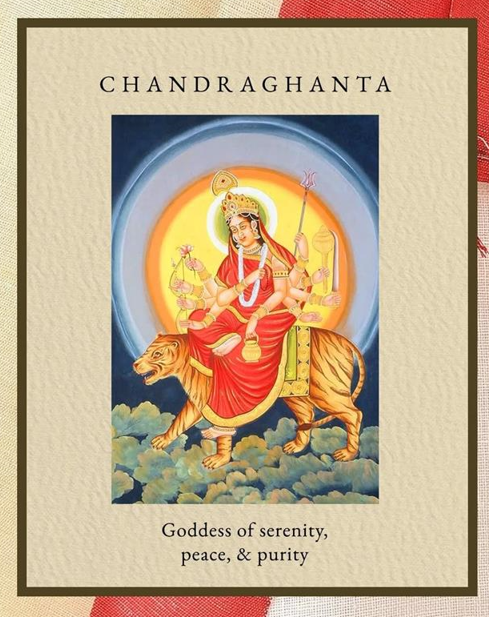
Just like her name, after her nuptials she placed a crescent moon (Chandra) on her forehead. But when demons tried to disrupt the harmony of the universe, she took her third form, a fierce warrior.
What she represents?
Riding a golden tiger symbolizing courage & strength, she roared into battle, her ten arms wielding weapons of destruction. Her third eye symbolising her inner vision, seeing truths beyond physical world blazed like fire, striking terror into the hearts of demons. The mere sound of her bell sent them fleeing in fear. Chandraghanta is the divine protector of righteousness, reminding the world that grace & fury coexist. An epitome of courage, fearlessness, & justice, teaching us to fight for what is right.
In modern life, she shows us whether dealing with workplace pressure, personal struggles, or societal expectations, facing situations with courage & confidence ensures success.
How to Awaken Chandraghanta Within
- Balance power with grace – Embrace both fierceness and grace—whether in the boardroom, in relationships, or in personal battles.
- Protect your energy – Set emotional, mental, & professional boundaries for your well-being & self-respect.
- Don’t let fear hold you back – To be fearless, start trusting the process, believing in oneself, & having faith in a higher plan
Phase 4 – Maa Kushmanda – The Creator
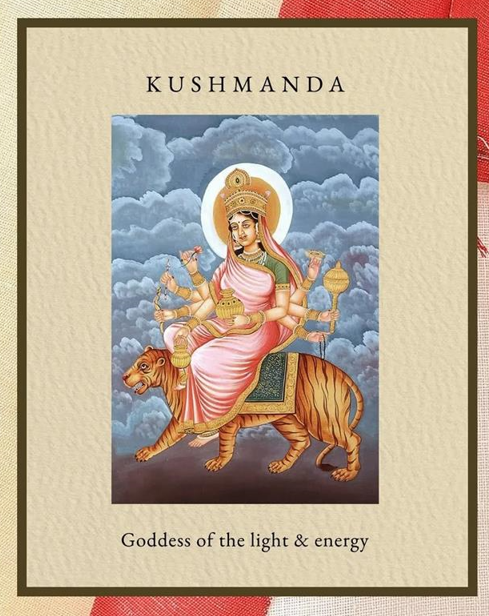
Kushmanda, means “little cosmic egg,” is the divine creator of Brahmanda (the universe). In her fourth form, she shaped the sun, stars, planets, & all life, illuminating existence with her boundless energy.
What she represents?
Seated on a lion, she wields eight arms, carrying a chakra, bow, arrow, & kamandalu, symbolizing creation & boundless cosmic energy. As the source of light & vitality, she blesses her devotees with strength, prosperity, & health, embodying new beginnings, inner power, & infinite creativity.
Even in the darkest times, she reminds us that a single smile of hope can give birth to a universe of possibilities.
Awakening Kushmanda Within
- Harness the Power of Creation – Stay curious, nurture fresh ideas, & seek opportunities for growth. A creative mind remains forever young.
- Cultivate Inner Resilience – True strength comes from within. Believe in yourself, even when the path is uncertain, most great things are built on unwavering confidence.
- Small Steps, Big Impact – Every great achievement starts with a single step. Stay consistent, work hard, & watch your efforts transform into something extraordinary.
Phase 5 – Maa Skandamata – The Nurturer

Skandamata, goddesses fifth form is an amalgamation of Skanda warrior god Kartikeya & mata mother thus she was known as the mother of a warrior. Her blessings bring courage, success, & the power to overcome obstacles.
What she represents?
Holding her child Kartikeya in her arms, riding a lion, radiating divine love & protection. Her four arms carry a lotus & blessings for her devotees. She shows us that a mother’s love is not just nurturing but also a shield against all adversities.
Awakening Skandamata Within
- Be Compassionate – Nurturing is a strength, not a weakness, it takes immense strength to support & uplift others while standing firm in your own power
- Maintain a balance between kindness & discipline – These qualities are essential in leadership, parenting & personal growth
- Protect What Matters Most – Safeguarding your values, mental well-being, & loved ones is crucial, they make you who you are
Phase 6 – Maa Katyayani – The Warrior

The one who fulfills wishes, Katyayani, the sixth avatar of the goddess, was born from the collective energy of the gods as an answer to their prayers when the demon king Mahishasura unleashed terror upon the heavens. With unmatched valor, she descended to restore cosmic balance, her presence radiating both grace and indomitable strength.
What she represents?
Fierce & radiant, with four arms, a sword in hand, & a lion as her vehicle, she led the battle against Mahishasura, ultimately slaying him. She is the embodiment of shakti (power) & justice, teaching us that divine intervention comes when injustice crosses its limits.
Awakening Katyayani Within
- Act – Change happens when you take bold steps, not just talk about it.
- Stand Up for What’s Right – Standing up against injustice may be tough, but in the long run, it will always be worth it.
- Be Persistent – Challenges are omnipresent whether it’s in careers, relationships, or self-growth, but persistence & effort will always lead to success.
Phase 7 – Maa Kalratri – The Destroyer

Her seventh and fiercest form, Kalratri, is a fusion of two powerful words—Kaal, meaning time or death, and Ratri, meaning night—symbolizing the ultimate force that brings an end to darkness and evil. When demons threatened the cosmic balance, she emerged in this terrifying form, embodying the raw, untamed energy of destruction that paves the way for renewal and rebirth.
What she represents?
Adorning wild hair, a dark complexion, & a blazing third eye, she rode a donkey symbolizing that divine power is available to everyone, not just the privileged or powerful, wielding a sword & a deadly iron hook. She is both terrifying & protective, reminding us that destruction is necessary for renewal. Kaalratri annihilates fear, evil, & ignorance, lighting the path to transformation.
She is the remover of darkness, guiding us through challenges toward strength & wisdom.
Awakening Kalratri Within
- Remove Negativity – Be it self-doubt, limiting beliefs, or toxic influences, potect your peace by surrounding yourself with positive energy & strong intentions.
- Understand transformation is necessary for renewal – Let go of toxic relationships, outdated mindsets, or unfulfilling careers for growth.
- Face challenges head-on – Conquer your fears & unlock your true strength to rise above obstacles.
Phase 8 – Maa Mahagauri – The Forgiver
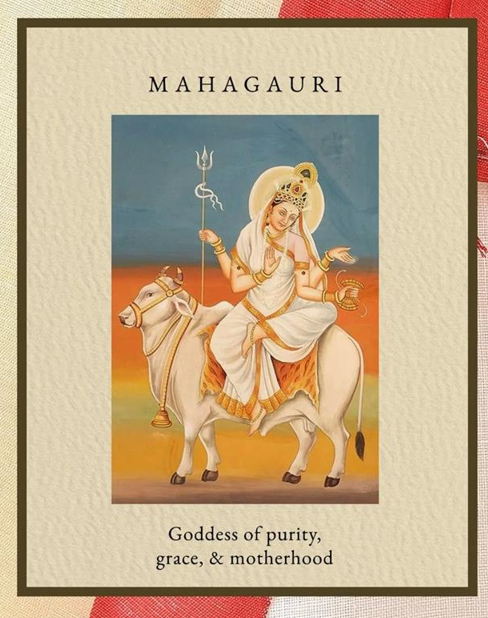
Mahagauri, meaning “great white,” represents the purest & most radiant form of the Goddess, glowing like the soft light of the full moon. She is the epitome of serenity, patience, and ultimate liberation, symbolizing the spiritual transformation that occurs when one sheds impurities of the mind and soul.
What she represents?
She embodies forgiveness, peace, & wisdom, riding a white bull—a symbol of purity, righteousness, & truth. In one hand, she holds a trident, signifying the release from past, present, & future karmas, while the other carries a drum. She teaches us that after every storm, calm follows, & after struggle comes liberation.
Awakening Mahagauri Within
- Maintain inner peace – Engage in activities that bring mental clarity like meditation, journaling & self-reflection.
- Let Go of the Past – Release grudges, regrets or old fears instead focus on self-improvement by setting new goals that align with your growth & aspirations
- Cultivate Patience & Grace – Stay calm while handling conflicts as it exudes grace & composure
Phase 9 – Maa Siddhidatri – The Bestower

On the ninth & final day of Navratri, we celebrate Maa Siddhidatri, the ultimate form of the Goddess and the divine bestower of supernatural powers, wisdom, & enlightenment. Her name is derived from “Siddhi”, meaning spiritual perfection or divine abilities, and “Datri”, meaning the giver. As the supreme nurturer of knowledge and higher consciousness, she grants eight powerful Siddhis, spiritual attainments that liberate one from worldly limitations. It is believed that even Lord Shiva attained his divine completeness by worshipping her, leading to his transformation into Ardhanarishvara—the perfect balance of masculine & feminine energies.
What she represents?
Seated on a lotus, she signifies the culmination of the spiritual journey, holding a chakra, conch, & mace—symbols of wisdom, fulfillment, & the harmonious union of masculine & feminine energies. Siddhidatri reminds us that true success comes from self-awareness, faith, & the pursuit of higher knowledge representing the final goal of spiritual awakening—oneness with the universe.
Awakening Siddhidatri Within
- Be Selfless – Share knowledge & use your skills to make meaningful contributions
- Attain wisdom – Read, learn, listen more, speak with intention & Seek experiences that broaden your perspective
- Balance Material & Spiritual Growth – Practice gratitude to stay grounded despite success
The Navadurga symbolizes not just cosmic power but our own inner journey. From devotion (Shailaputri) to discipline (Brahmacharini), courage (Chandraghanta) to creativity (Kushmanda), motherhood (Skandamata) to warrior spirit (Katyayani), destruction (Kalaratri) to purity (Mahagauri), & finally, self-realization (Siddhidatri)—each form teaches us a lesson in strength, perseverance, & divine grace.
Taking inspiration from the Devi’s may we awaken the Shakti within ourselves, embracing courage, wisdom, & boundless potential.
The Goddess Within
The streets of Kolkata shimmered under the golden glow of Durga Puja lights. The air was thick with the scent of incense, laughter, & the rhythmic beats of the dhaak. Among the bustling crowd stood Meera, her hands folded before the grand idol of Maa Durga, her eyes searching for answers. For the world, Meera was just another girl—young, ambitious, & full of dreams. But deep inside, she carried battles no one saw. A job where her voice was ignored, a family that still thought marriage was her biggest achievement, & a love that had left her in pieces. Standing before Maa Durga, her heart whispered, how do you do it? How do you destroy demons & remain so radiant? The priest’s voice broke her thoughts. “Shakti is not just in the goddess you see, but in the fire within you.”
Meera’s gaze shifted from the idol to the women around her. A mother balancing a baby on her hip while bargaining at a food stall. A college girl laughing with her friends, unafraid of the world’s gaze. An old woman, her hands wrinkled but her spirit unshaken, singing the Aarti. And then, she saw her own reflection in the silver plate of offerings—eyes fierce, unbowed. A slow smile formed on her lips. Maa Durga wasn’t just on the pandal’s pedestal. She was in every woman who fought, who dreamed, who loved, who never gave up.
As the shank blew, Meera took a deep breath. The demons in her life would not define her. Like Maa Durga, she was born to rise & conquer. And with that, she walked away—not seeking blessings but carrying the goddess within her.
As Navratri unfolds & we celebrate the Goddess in her many forms, we also celebrate the modern-day woman navigating different phases of life—soft yet strong, gentle yet fierce, rooted in tradition yet embracing change. In a world that often values speed & logic over depth & intuition, the divine feminine reminds us to pause, to feel, to heal, & to lead with wisdom. Let us always remember it’s the quiet strength that endures, the creativity that inspires, & the love that transforms.


 Storytellers of Wonder
Leave a comment