
As the train journeys through the lush paddy fields of Bengal, I look out of the tinted window to catch a glimpse of the passing villages. I cannot help but think about the many facades of the lives in these villages, of their heartfelt people, and the abundance of nature. Among the many places that pass by is a place home to the distinguished craft of Jamdani. A weave so fine and legendary that the renowned Sufi poet Amir Khusro called it “The skin of the moon”.

Jamdani is not merely a saree, fabric, or a weave but a pride for the weavers and an emotion for the country. Its history, laced with romanticism, has been a subject of admiration among poets, authors, and travellers alike. Its weaving process is known as one of the most complex handweaving techniques in the world, producing fabric so soft that it passes through a signet ring.
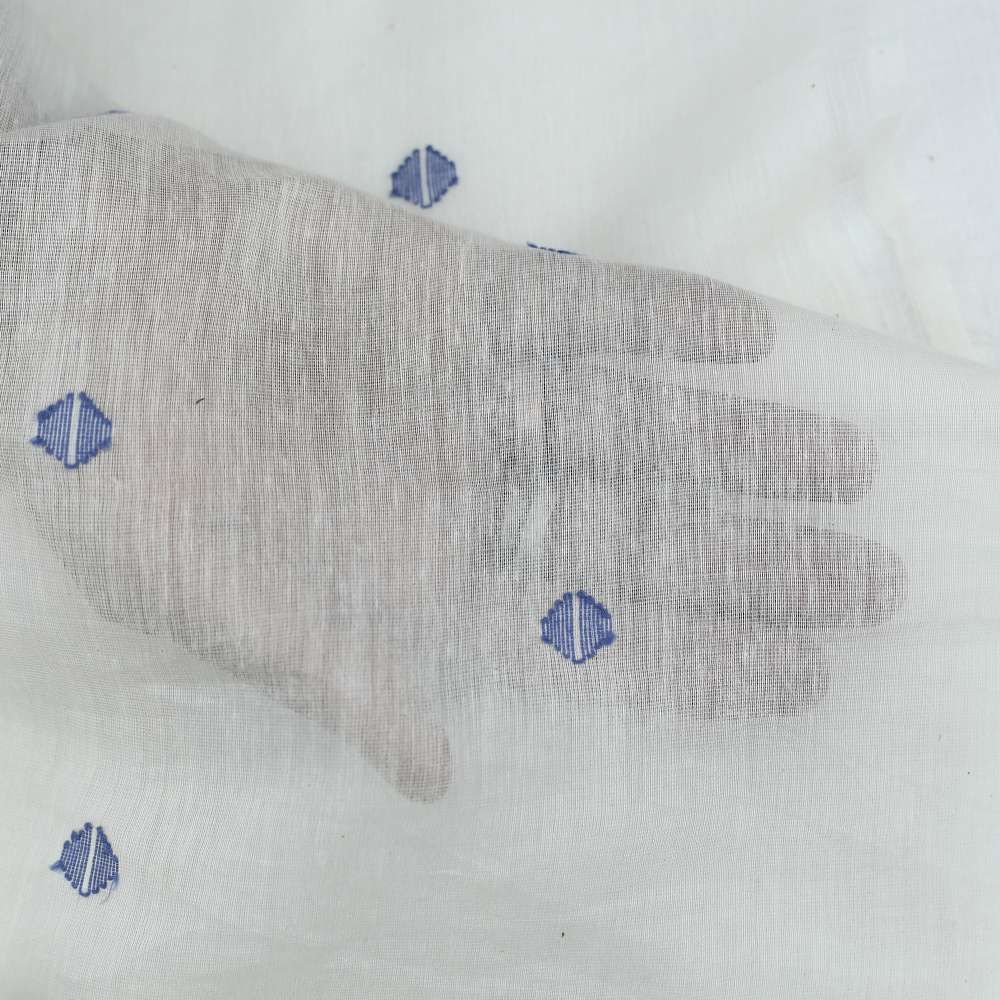
The word Jamdani finds its roots in the Persian words Jam and Dani. While “Jam” signifies a flower or floral, “Dani” means a vase, indicating the intricate floral patterns distinct to the craft. Looking at this translucent fabric feels like a wispy dream that, when touched, melts in hand.
The Chronicles of Jamdani
As I alight from the train in one of the weaving villages of Jamdani, I am transported back to my childhood days. Growing up, I heard numerous myths and tales about Jamdani from my mother. I still remember one such tale vividly. During the British colonial period, weavers from undivided Bengal were highly prized for their exceptional weaving skills. They weaved the fine artisanal Jamdani fabric, whose feather-like softness was secondary to none in the world. This led to a thriving textile industry, which hindered much of the Britisher’s textile counterparts. To limit the growing production and competition, the British levied heavy taxes on the weavers. They even went so far as to cut off the thumbs of the weavers to further limit production and stagnate the critical knowledge flow to the next generation. Such is the history and myths of Jamdani, intertwined with romanticism and violence.

While its roots trace back to the Maurya Empire around the 3rd century BCE, it was during the Mughal era, particularly under Emperor Jahangir’s reign, that Jamdani reached its zenith. The Mughal patronage elevated this textile to royal status, with the finest Jamdani being produced in Dacca (now Dhaka, Bangladesh).
While mentions of the craft can be heard throughout the corridors of history, it was a 9th-century traveller named Sulaiman who first wrote about it. His records talk about a fine cotton fabric which was so soft that it could easily pass through a ring. As time advanced, so did the craft. The changing cultural tapestry opened new arenas for the weavers to imbibe various Islamic influences and translate them into motifs and patterns of the saree. What emerged were distinct floral, vine, and leaf motifs that often carried a geometric connotation.
The Weaving Art of Jamdani
At first, the quiet weaving village seemed like nothing extraordinary. It mirrors any other quaint little hamlet, complete with winding roads, giant fruit-bearing mango trees, and the gentle cacophony of the villagers going about in their everyday lives. However, inching further deep into the lanes paints a different picture. I am greeted with the rhythmic sounds of the handloom and visuals of yard-long sarees left under the sun to dry before they reach the market.

Upon a little inquiry, I am led inside one of the master artisan’s homes, which doubles as a weaving studio for the family. Inside is a different world. At one corner, you can find the handloom looming large over the room. Adjacent to it lies the many shuttles, yarns, and threads used for the weaving process. At the other end of the room, a tiny corner is dedicated to the local deities, symbolizing the deep synthesis between their craft and devotion.
While much is cherished about the sarees and the fabric, it is the weavers whose relentless efforts and exquisite craftsmanship make it possible to drape such finery. Weavers can use anywhere between 40 to 120 counts of threads to weave a Jamdani saree. It is this meticulous precision that lends Jamdani the iconic soft and wispy texture.
Let’s unravel the detailed process of Jamdani:
- Yarn Preparation
The base fabric of Jamdani is most often ultra-fine cotton, known more famously as muslin—a fabric so soft and sheer that poets once described it as “woven air.” Traditionally, this was crafted from Phuti Karpas, a rare native cotton variety, now nearly extinct. Today, high-count cotton yarns, often in the 80s to 250s are used to retain that original finesse.
Before setting the yarns on the loom, they are treated with a special rice starch (maida or sago-based paste). This not only strengthens the fragile threads but also allows them to endure the tension and repetition of the weaving process. After drying in the sun, these starched threads are wound into bobbins or spools using the humble charkha —a familiar sight in every artisan household.
These prepared yarns are dyed in a variety of colours—often natural or azo-free chemical dyes, depending on the motif palette. Once dried and reeled, the coloured spools are sorted for their respective roles in the warp or tana (longitudinal threads) and weft or bana (transverse threads), ready to be mounted on the loom.
- Designing & Graphing
Motif-making in Jamdani is a unique art form in itself. The designs are either hand-drawn on graph paper or recreated from memory, a cherished oral tradition among master weavers. These motifs, be it butidar (floral sprigs), tercha (diagonal vines), ashrafi (coin shapes), or kalka (paisley), often draw inspiration from nature, Mughal aesthetics & Bengali folklore.
Each design is meticulously plotted, with every square of the graph denoting the placement of a warp and weft intersection. It serves as a visual guide, usually pinned under the warp threads for constant reference.
- Setting the Handloom
Weavers typically use horizontal pit looms, slightly sunken into the floor to provide ergonomic support during long hours of weaving. The warp threads—up to 10,000 fine strands—are carefully threaded through the reed and heddles, often made of bamboo and wood.
This stage is deeply ritualistic, many weavers perform a small prayer before beginning the setup, invoking blessings for precision and patience.
- Floating Motifs by Hand
What makes Jamdani distinct is the extra-weft technique (par or buti tana in local parlance). Unlike printed or embroidered designs, Jamdani’s motifs are woven in-situ, using an additional weft yarn that is manually inserted by hand, one motif at a time. Using a thin bamboo stick or a blunt needle, the artisan interlaces coloured yarns over selected warp threads as guided by the design graph. This results in patterns that appear to float like embroidery on the translucent muslin base.
In complex designs, two artisans often sit at one loom—one managing the base weave and the other working on the motifs. The coordination, built over years of practice, is nothing short of choreography.
Depending on intricacy, a Jamdani saree can take from a few weeks to six months or more to complete—especially for all-over jaal (netted) patterns.

- Finishing Touches
Once off the loom, the saree is washed to remove residual starch, then sun-dried and pressed—often using traditional heavy charcoal irons. Edges are hand-hemmed, and some sarees feature delicate selvedge (kinari) embellishments or tasseled pallus (lombas), giving each piece a signature finish.
A Timeless Artisanal Craft
As I sit listening to the master weavers, it becomes evident that it can take days to months to weave one saree. The craft is not just their bread and butter but an identity that they are proud of. It unfolds the dynamics of the delicate connection between heritage and exquisite craftsmanship. The knowledge and skill sets gathered by the elders are passed on to the next generation, preserving the living traditions. It is the passion, artistry, and dedication of the countless weavers that is reflected in each of the delicate weaves of a Jamdani saree. Draping them is not just a luxury but a tribute to the weavers and their exceptional craftsmanship.
As I bid goodbye to the weavers, I took with me a heartfelt gratitude and an intangible knowledge of witnessing one of the most profound crafts to ever exist. It reminds us of the diverse craft ecosystem of India and the rich cultural heritage that we are part of. Draping a Jamdani saree is a celebration of the unmatched artisanal craftsmanship and the age-old living craft traditions of the country.
Draping Heritage, Empowering Hands
Embracing a Jamdani saree is more than a sartorial choice—it’s an homage to centuries of artistry, cultural memory & intergenerational skill. Each thread, each floating motif, carries the quiet resilience of artisans who have safeguarded this ancient craft through changing times.
At Jaypore, we believe in honouring these timeless traditions by offering a platform for master craftsmen to share their artistry with the world. Our Jamdani collections are a celebration of these weavers—keepers of history and creators of beauty—who continue to breathe life into their looms with passion and precision. By choosing Jamdani, you don’t just drape a story—you become a part of it. You help carry forward a legacy woven with patience, heritage, and pride.
Let the threads of the past become part of your present—only at Jaypore.



 Storytellers of Wonder
Leave a comment