
My first encounter with Rajasthan wasn’t through a plane ticket or travel itinerary—it began much earlier, through the vivid hues of daily soap operas and the cinematic magic of Bollywood. The elaborate poshaks, majestic palaces, and rustic desert backdrops painted a picture so enchanting that it etched itself deep into my imagination. Even before I ever set foot there, I knew I was drawn to this land of stories, tradition & craft.
So, when the time came for my first solo trip (armed with a camera), I instinctively chose Udaipur. Often referred to as the “City of Lakes,” Udaipur didn’t just live up to the imagery I had grown up watching—it surpassed it.
The initial days were spent meandering through the sprawling courtyards of the City Palace, gliding over the serene waters of Lake Pichola, and strolling past the vibrant chaos of Hathi Pol Bazaar. But amid all the royal grandeur and postcard-perfect views, what truly took my breath away was something far more grounded: the exquisite art of block printing.
Tucked between miniature painting stores and trinket-lined stalls were stacks of hand-block printed textiles—each piece a canvas of intricate patterns, age-old stories, and soft, breathable cotton. Running my fingers over the dyed fabric awakened something visceral in me. The symmetry of the hand-stamped motifs, the earthy pastels alongside riotous hues—it all felt like poetry in pigment.
Visiting Udaipur and not being swept away by the beauty of its textiles, especially the heritage of block printing, would be like skipping the soul of the city. Because here, craft isn’t just a livelihood—it’s a legacy.

With a legacy spanning more than 1,000 years, block printing is the craft of using hand-carved wooden blocks to create prints on textiles. What makes this craft a living tradition, reflecting India’s rich craft heritage, are the master artisans behind it. For them, it is not just work but a ritual, without which their life would be different. While many artisans have been practising the craft around the country, it is the Chhipa community of artisans from Rajasthan who form the backbone of the block printing ecosystem. Their artistic expression and unparalleled skills reverberate throughout history, making them and their knowledge an intangible affair revered by all.
Table Of Contents
- The Convoluted Yet Rich History of Block Printing
- The Unique Process of Block Printing
- Block Print: A Testament of Time
- Celebrating Craftsmanship & Heritage: One Block at a Time
The Convoluted Yet Rich History of Block Printing
Much of block print’s history has been lost in time, while a greater portion has been conserved. It is believed that the art of using wooden blocks for printing on fabrics emerged in China around 4,500 years ago. However, as it dissipated in various regions of Asia, it was the assimilation in the Indian subcontinent where it reached its pinnacle. With the availability of natural pigments and vegetable dyes coupled with the unmatched craftsmanship of the artisans, the craft held a venerated place.
The very first time it graced the Indian subcontinent was during the Indus Valley civilization, which is the present-day northwestern region of the country. Excavations carried by archaeologists revealed spindles, needles, dyed cotton fabric, Madder, and many such artefacts that corroborated the extensive practice of block printing. Although quite surprisingly, the first ever evidence of block printing was found not in fabric but in a book called Diamond Sutra, a Buddhist text published around 868 C.E.

While block printing steadily gained recognition and its fabrics traded with the ancient world, it saw a new wave of acceleration during the Mughal period. With their ardent love for art, textiles and culture, the Mughals became a royal promoter of the craft. What caught their attention was the rich visual expression of colours and patterns of block printing. The artisans, influenced by Persian art, introduced intricate floral patterns, taking a more curvilinear design approach. This aesthetic is still largely seen today in the block printed fabrics originating from Rajasthan.
With time, block printing diverged into other craft forms while keeping the use of wooden blocks central to the printing process. What emerged were the distinct crafts of Ajrakh, Dabu, and Bagh from the regions of Rajasthan, Gujarat, and Madhya Pradesh. The artisans of these crafts use some form of mordants and mud resist techniques along with block printing to create the prints. This granted the artisans greater freedom in creating unique, complex designs that became the hallmark of the craft.
The Unique Process of Block Printing
As I gathered information about the clusters for block printing, the town of Sanganer kept resurfacing among the locals and in information brochures. Just about 16 kilometres outside Jaipur, the town of Sanganer is world-renowned for its vibrant Sangeneri print. So much so that Sir George Watt called the town “The capital of hand-block printing” in 1902. It is a type of block printing known for its vibrant visual vocabulary with exceptionally intricate floral patterns on white or off-white fabrics.
A short journey later, I arrived at the sunlit streets of Sanganer. With quite a pulsating heat and breeze on my face, I decidedly roamed around the town. As I approached the narrow alleyways, the thump sound of stamping of wooden blocks on fabric and the sharp metallic clang of hammer on chisel carving out the design on the wooden block became coherent. The hand-block printing craft is mostly hereditary, with the Chhipa community practising it in Rajasthan for centuries.
The craft involves a series of steps that are done by different groups of craftsmen. The technique has ever so slightly changed over centuries, making it a living tradition. With such finesse in craftsmanship, let’s unravel the elaborate process of block printing:
- Carving the Wooden Block
The first process in block printing is to source the wood to hand carve the design. Usually, teak, Sheesham, or rosewood are used for the blocks. Once it is sourced, it is seasoned properly to avoid any cracks or warping. A minimum of two or three variants of wood are warped together to engrave the design. These blocks are kept at a minimum of 2-3 inches thick for correct warping. Once seasoned, the artisans trace the design on the wooden blocks.

Next, using a chisel and hammer, the artisans start engraving on the wooden blocks. It is a labour-intensive process and can take hours to complete a single block of wood. Each block is reserved for a single motif or colour. It requires several wooden block pieces to complete the entire printing on one stretch of fabric and can even go up to 30 or more to create a complex pattern.
Over the years, metal plates, the kinds of copper, have been used for printing. What makes their use relevant is the ease of creating intricate reliefs quickly and efficiently as compared to chiselling on wooden blocks. However, this is not a common practice followed by most artisans.
Usually, the artisans involved in wood carving are not engaged in the printing process. These processes are done by two different sets of artisans, lending greater efficiency to the process.
- Preparing the Fabric
Preparing the fabric for the printing is carried on simultaneously with the wood carving by a different set of craftsmen. It is an important step that involves removing any impurities and starch from the textile and making it ready to catch the dye. A solution of castor oil, soda ash, camel dung, and water is mixed together until it becomes frothy. The fabric is then immersed in this solution. Next, it is then taken out and left under the sun to dry. This treatment can be repeated several times until the fabric gets completely bleached.
A mordant is often used in the case of cotton fibres to control the intensity, colour fastness, and hue. This mordant is mostly made from Myrobalan (Harde), which is a strong tannin obtained from the fruit of Chebulic Myrobalan. It is a naturally occurring mordant that has been traditionally used in India for centuries.
- Preparing the Dye
What lends block printing the vibrant hue is the intense colours of the natural dyes. With advanced technologies, there is a visible shift in using synthetic dyes, and yet many artisans remain rooted in natural pigments. The vegetable dyes are mostly made from indigo for blue, madder root for red, pomegranate peel, catechu, myrobalan, harda (Terminalia Chebula), and many more such indigenous plants.

- Making the Imprints on the Fabric
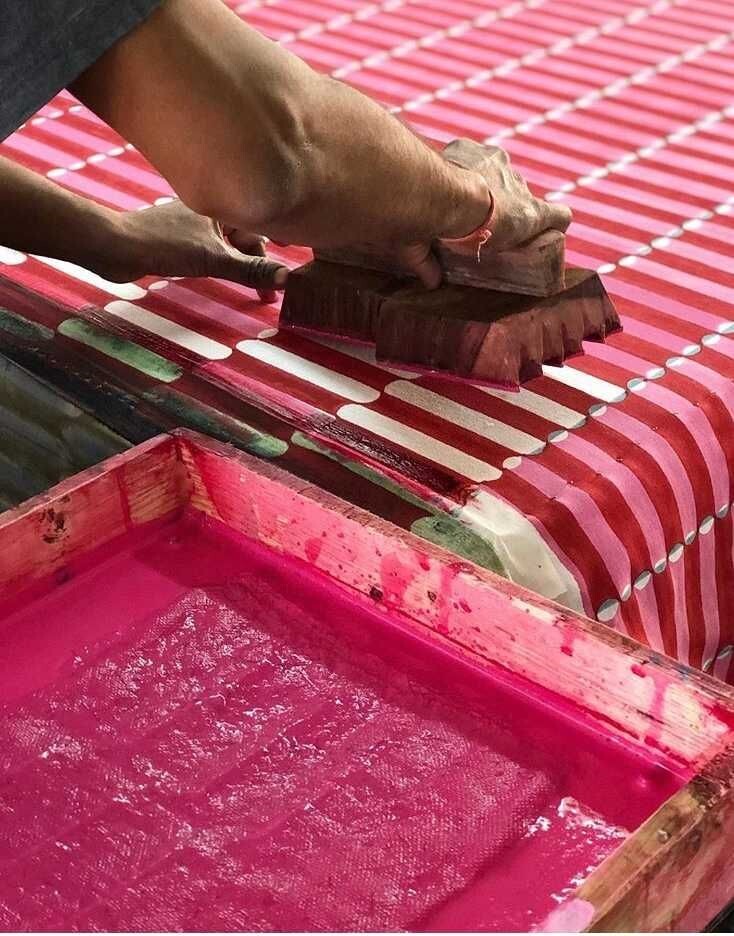
There are several small but crucial steps involved in this process. The first is to pour out the ink or dye in a flat tray. This helps in forming an even coating on the wooden block’s surface. Meanwhile, the stretch of fabric is rolled out on a table and pinned properly to exert an even tension on all sides. This helps in forming a clear and clean imprint on the fabric.
- Registering the Imprint
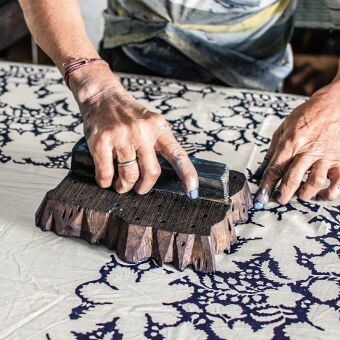
In the successive step, the artisans dip the hand-carved wooden blocks into the tray consisting of the dye and gently place it on the textile. A short and quick pressure is applied on the wooden blocks to leave behind a strong print on the fabric. The process is repeated numerous times until the required stretch is completed. This process requires exceptional craftsmanship and a skill set to register the mark properly in the designated area on the textile.
The artisans make sure that the previous impression’s last point is the starting point of the next motif. Thereby creating an unbroken chain of prints offering a visual element that feels as if it has been printed together at once.
- Washing & Drying
Once the prints have been made on the fabric, it is dried and washed thoroughly to remove any excess dyes. It is hung, dried, and inspected for any faults before it is ready to go on the market.
The block printing process can be of various types- direct, resist, and discharge. Each type varies based on the region, reflecting the diverse cultural practices and a profound synthesis between the artisans and their work. The design language is most often inspired by the natural flora and fauna of the region with the specific cultural connotation of the region. Many of these designs can also be seen in the palaces’ architecture of Rajasthan.
The minimal changes that the craft has witnessed over centuries are a testament to the undying love and desire of the artisans to be rooted in their craft practices. Thus, preserving the living traditions for the future.
Block Print: A Testament of Time
As I continue to observe the hard work of the artisans who allow me a glimpse into their workshops and a deeper insight into their everyday lives, it fills me with gratitude and pride. Every hand-chiselled block and stamping on fabric narrates the quiet brilliance of India’s artisans. Their practised hands breathe life into the motifs and patterns, preserving the age-old craft traditions. Their touch transforms every fabric into an enduring heirloom beauty.
Celebrating Craftsmanship & Heritage: One Block at a Time
Block printing is more than just exquisite craftsmanship—it’s a testament to the patience, precision, and passion of India’s master artisans. Each hand-carved block and every impression on the fabric carries with it generations of heritage and artistic soul.
At Jaypore, we celebrate this timeless craft by bringing you collections that reflect the beauty of handmade excellence. Our thoughtfully curated range of block-print collection kurtas, sarees, and home décor not only honours the hands that make them but also brings a piece of India’s rich textile heritage into your everyday life. Unravel the artistry of block printed textiles and feel the legacy—only at Jaypore.



 Storytellers of Wonder
Leave a comment