
Once upon a time, when art was not just brushstrokes, but a breath tinged with the rhythms of life, the smell of earthy musk, and whispers from the rain-washed forests, a folk art was born deep within the forests of central India. Gond painting is not merely colours on mud walls but the heartbeat of the villagers. Every swirl and dotted line are a visual splendour safeguarding the tribal folklore and deities, becoming a living narrative of people, culture, and mythology.

Long before any modern galleries hosted exhibits, the mud walls became the canvas for Pradhan Gonds. They sang stories of Mahua trees to children, danced with the spirits dwelling in forests, and painted their lives on the mud walls of their huts, blurring the lines between art and life. Each brushstroke is like a ritual that is passed down from grandmothers to grandchildren, becoming a living inheritance. Derived from natural pigments, including leaf dyes, charcoals, ochre soils, and more, the Gond painting embodies the deep synthesis of its people and their surrounding nature. The dotted curvilinear lines often portray the ‘The Tree of Life’, local legends, and everyday lives, becoming an invocation to life and divinity beyond.
Today, Gond art has journeyed beyond the mud walls and village courtyard into the international runways and shelves. Yet, at its heart, it is an invitation to step into a world filled with myths, nature, people, and folklore that makes Gond art eternally alive.
Table of Contents
- The Gonds- Guardian of the Gond Art
- The Story of Mahua Tree: The Guardian Spirit
- The Visual Documentary of Gond Painting
- The Tools, Techniques, & Colour
- Beyond the Mud Walls: Gond’s Contemporary Evolution
- A Curated Offering by Jaypore
The Gonds- Guardian of the Gond Art
The Gond tribe are among the largest indigenous communities in India. They are primarily found in the central, south-central, and eastern regions of the country, including Madhya Pradesh, Chhattisgarh, Odisha, Andhra Pradesh, and Maharashtra. Known for their vibrant culture and deep animistic belief, the Gond people are the guardians of the Gond Art.
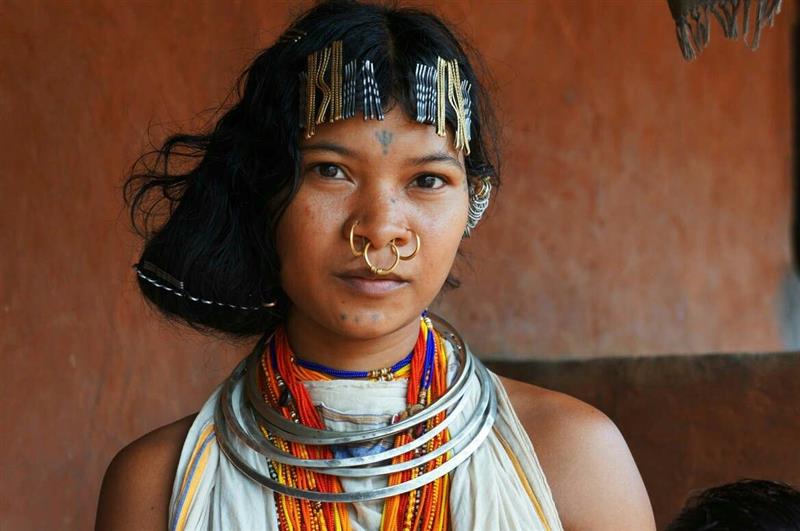
The word Gond comes from Dravidian expression ‘Kond’, meaning green mountains. Their lives and beliefs are deeply intertwined with the surrounding lush nature, which is visibly reflected in the Gond paintings. For them, every natural element, be it trees, rivers, stones, or mountains, is alive and thriving, not just metaphorically but spiritually. Nature is deeply embedded into their soul, which forms the basis of their art.
Traditionally, Gond paintings are created on the mud walls of their dwellings during auspicious festivals and rituals, such as marriages, births, Karama, Hariyali, and others. Each smear of paint tells a story narrated to preserve ancient customs and remember the ancestors. They are like blessings of their ancestors and offerings to the gods and the forest.
The Story of Mahua Tree: The Guardian Spirit
In a world where stories are sung and where art is not created but remembered, folklores are like portals to a different world crafted with mysticism and belief. One such folklore is of the Mahua tree, a revered and sacred life-giving symbol for Gond.
In a time when gods ruled supreme, the first Mahua tree was gifted to the Gond people and was believed to protect and sustain them. The tree provided them with food, shelter, water, and firewood, all of which helped them sustain a bountiful life.

The spirit living inside the branches of the Mahua tree was generous and protected the villagers from any passing danger and watched over them, ever vigilant. But with time, the greed and lust of humans knew no bounds and thus began their exploitation. This prompted the sacred spirit to withdraw the blessings, leaving the Gond people in peril. Drought and disease became commonplace, leading them to realise their mistakes. They repented and vowed to respect nature and spirit again.
To this day, during the various festivities that the Gond tribe celebrates, the Mahua tree remains an ever-present reminder of the silent might of nature, carried in its gentle breeze and cascading rainfall. It is painted with vibrant natural colours on mud walls in honour of its spirit.
The Visual Documentary of Gond Painting
What makes Gond art instantly recognisable among the scores of painting art forms is its rich visual vocabulary. The lives of the Gond people are nourished and nurtured by the various myths and legends that are cradled by nature. Their animistic beliefs forge a close bond with nature, which becomes the premise of much of their ritualistic practices. They express themselves through various dance forms like Rina, Saila, Dadariya, and music.
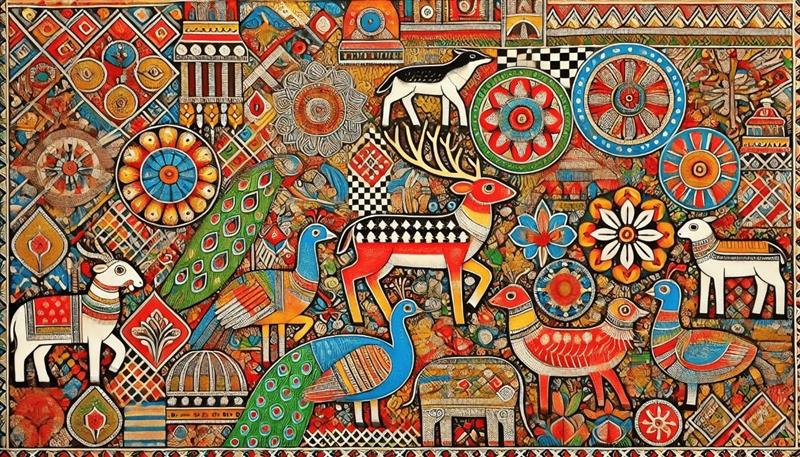
Their rich, expressive way of life directly translates into Gond painting, making it emotive with an intricate tapestry of dotted lines, rhythmic curves, and vibrant colours that fill every inch of the canvas. What pushes the traditional boundary of art form is the process of infilling spaces, locally known as ‘Bhitti Chitra’. It is the touch of this native dialect that makes the simple strokes into masterpieces of pulsating movements.
One of the many central themes that is repeatedly depicted in the painting is the ‘Tree of Life’. Its serpentine branches and foliage form a tapestry that covers much of the canvas. It is a symbol of life and its interdependence among living things. Each scene depicts the animals and flora of the region, becoming a story that has been told through generations.
The visuals in the painting might speak of a deer transforming into leaves to trick a demon or a river goddess whose beauty and reflection can summon the rains; each is a masterstroke of visual memory.
What dominates the canvas is its signature dotted lines. Along with it, the artists often use fine and curved lines, dashes, seed shapes, fish scales, water droplets, and geometrical shapes, that often carry a hypnotic connotation.
While the cultural vibrancy and artful strokes have been eminent, its beginning is rooted in the musical notes of the Pradhan Gonds. Pradhan Gond is a subsect of the Gond tribe, who were traditional musicians and storytellers of the community. For centuries, they have narrated stories, myths, and legends using the traditional stringed musical instrument known as the Bana. In village gatherings to festivals, Pradhan Gond’s melodious tunes soothed the soul and entertained the hearts of the community while also preserving the stories. It was these songs that were eventually translated into rich visual motifs, giving rise to Gond art.
The Tools, Techniques, & Colour
For centuries, Gond painting has been done with natural dyes and pigments. Yellow from turmeric, red from Geru (a type of earth clay), white from rice paste, black from charcoal, and many other such natural derivates are still used by the artisans. However, as with any art form, with contemporary evolution, many Gond artisans have incorporated acrylic paints and changed their medium. However, the central theme and signature style remain exacting.
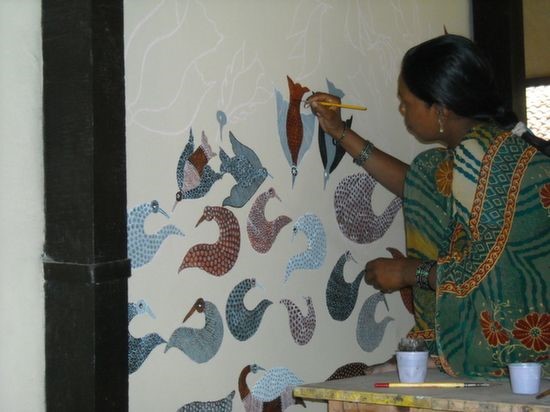
Originally, the Gond painting was done of the mud walls of the huts they built. The broad dotted lines present a vivid image of the local deities, animals, and flowers. What makes the painting more interesting is the use of multiple colours to paint a single figurine, with evocative eyes offering an almost hypnotic feel to the painting. The traditional choice of brushes was mostly made of bamboo or twigs. It has now evolved to include more modern craft tools. It takes days and weeks to complete a painting, making it a time-honouring craft.
Beyond the Mud Walls: Gond’s Contemporary Evolution
Till the 1980s, Gond art was largely confined to the tribal hamlets practising the art. This changed once J. Swaminathan, a modernist artist and curator, chanced upon the Gond paintings of Jangarh Singh Shyam in Patangarh village. Jangarh Singh Shyam’s art form transformed and shaped the very foundation of the contemporary art world in India and beyond. His work was unlike any other artist of any era. He started a new school of thought in Indian art known as Jangarh Kalam. The use of unusual colours and varied textures was his signature style, for which he was widely celebrated. While he kept the traditional soul of Gond art intact, his tacit contemporary execution achieved global recognition.

Today, Gond art has found its execution beyond the walls of tribal homes. From canvases to textiles to home decor, the revival of Gond art has opened wider avenues for traditional artisans to reach a varied audience and are much appreciated for their art.
A Curated Offering by Jaypore
At Jaypore, we honour the artisans and the rich culture. Our Gond art home decor items are not just that but a living heritage. It transcends the boundaries of artisanal pieces into a conversation between various cultures of the past and present. Each piece in our Gond Art collection has been thoughtfully curated, echoing the culture and lore of the Gond tribe. Let the whispers of the forest and the magic of folklore be part of your life with Jaypore.

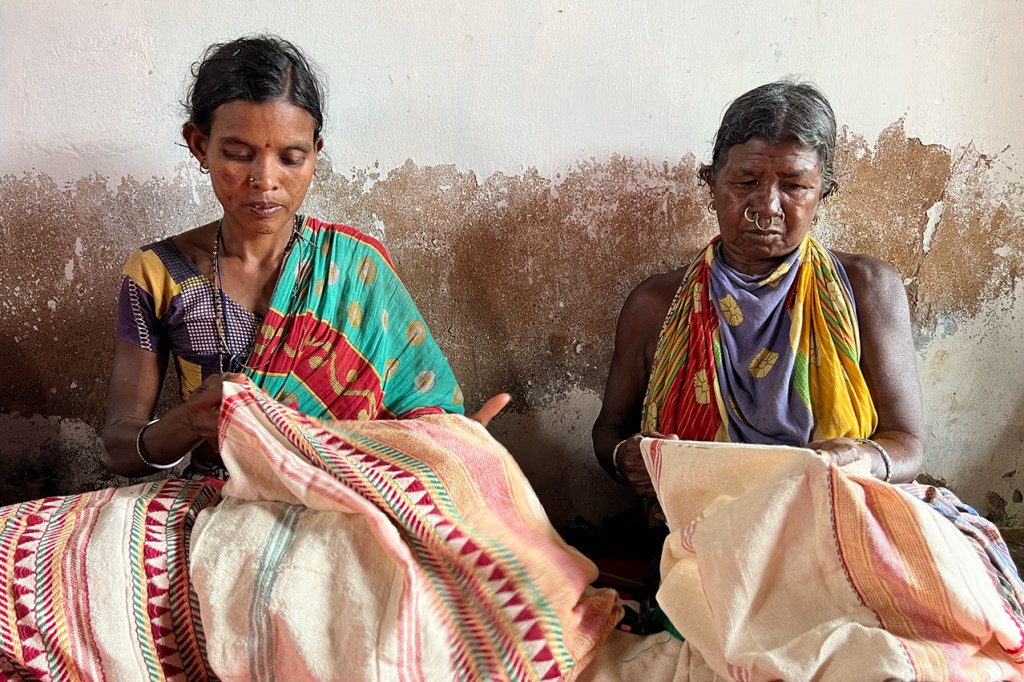

 Storytellers of Wonder
Leave a comment