
Long before I draped my first saree and stepped into the world of womanhood, I found my first invocation to femininity and six yards of pure elegance in watching my mother pleat her saree. On one of the many breezy evenings that I sat in front of her, utterly captivated by the sway of her pallu as she adjusted it, what caught my attention this time was not just the grace- it was the tales of divine love and retelling of the epic mythologies that came alive on the Baluchari saree. This was not just merely a saree, but six yards of unbroken exquisite craftsmanship that goes beyond any weave or weft.

Originating from the terracotta heartland of Bengal, Bishnupur, Baluchari sarees are the embodiment of narratives from the Ramayana, Mahabharata, and Rasa Lila, crafted in silk. Witnessing them feels like a moving fresco that preserves centuries of myths and memories. Among the many stories that the weavers weave, Lord Krishna’s love and Radha’s devotion towards him often find the centre stage. As the master weavers of Bishnupur sit behind the handlooms humming the tunes of folk songs, they just don’t weave the sarees but interlace them with myths and legends, making it a timeless beauty.
Table Of Content
- A Weave Woven in Time: The History of Baluchari Sarees
- The Intricate Jala Weaving Technique of Baluchari Sarees
- The Opulent Design Language
- Draping the Timeless Legacy of Baluchari Sarees
A Weave Woven in Time: The History of Baluchari Sarees
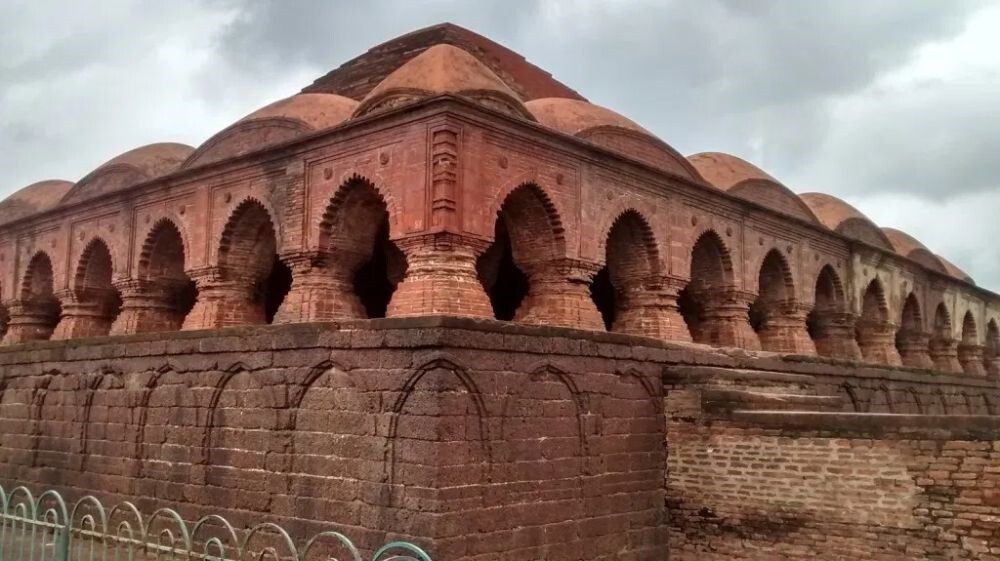
While Bishnupur is the current weaving hub of Baluchari sarees, its story began around the 18th century in the small village of Baluchar, located on the riverbank of the Bhagirathi in Murshidabad. The word Baluchari comes from the village’s name. The word ‘Balu’ in Bengali translates to sand, while ‘Char’ means riverbank, underscoring its geographical proximity to the Bhagirathi river.
Much of the craft’s booming popularity was due to the then Nawab of Bengal, Murshid Quli Khan. He is known to have introduced the weaving technique of the saree from Dacca, also known as Dhaka, in present-day Bangladesh. Under his royal patronage and immaculate vision, the craft of Baluchari sarees grew manifold, redefining luxurious textiles with opulent resham and retelling mythologies in exquisite motifs.
As the craft garnered adulation and praise from various royal courts, tragedy awaited around the corner. While the flooding of plains makes the rich soil of Bengal fertile, which offers a bountiful harvest, it often derails the lives of people. The last time flooding struck the quaint little hamlet of Baluchar, much of it was submerged under the water, forcing the weavers to take refuge in a new place. It was then that the weavers found a new home in the town of Bishnupur.
The Malla kings, who ruled the region at that time, welcomed them with open hearts and offered refuge. The Malla dynasty was renowned for its passion for art and architecture, which led to the commissioning of the historical terracotta temples in Bishnupur. Under them, the town became the new centre for weaving Baluchari sarees, which still exist today.
The Intricate Jala Weaving Technique of Baluchari Sarees
What made the craft of Baluchari sarees legendary was the Jala weaving technique. A lost weaving tradition that made weaving stories with unmissable intricacy on textiles possible. In the heyday, master artisans used Jala handlooms to weave the Baluchari sarees. Setting up the loom in itself was a task only a few could master. Let’s dive deeper into the Jala weaving technique in detail:
- Securing the Raw Materials
As with any handcrafted art, the foremost task is to source the raw materials. In the case of Baluchari sarees, it is silk, more specifically, Murshidabad silk. It is obtained from the mulberry silkworms (Bombyx mori). The fewer twists in the yarns of Murshidabad silk make it soft, fine, and lustrous. Once the yarns are made, they are dyed in vibrant colours for further weaving.
- From Jala to Jacquard Loom
The old Jala loom sets the Baluchari sarees apart from other weavings. The process began with master artisans drawing the design on paper. These were not ordinary designs but ones that narrated the stories of divine deities with intricacy and precision. These designs were then evenly transferred onto the threads with the help of wooden frames, locally known as machan. These became the original framework of the design, which lasted for centuries and could be used time and again for recreating the design.
What made Jala’s handweaving technique iconic is its reversible motifs. The weaving produced sarees that are completely reversible and can be worn on any side. This redefined fine craftsmanship and luxurious textiles. It took the artisans 15 to 18 weeks to weave one saree, becoming a time-honoured craft.

With the arrival of newer technologies, came the 20th-century contemporary alternative to Jala hand weaving. It was soon replaced by the much faster and easier Jacquard loom. The papers were replaced by punch cards, where the weavers punched the design onto them. The cards were then stitched together in the proper sequence and set up on a loom to create the same design on the fabric. This technique was efficient and reduced the timeline down to only a couple of weeks.
However, with every new invention that is adopted comes a drawback. For Jacquard, it was losing the master technique of making the sarees reversible. Any Baluchari sarees woven through a Jacquard loom are no longer reversible, losing their original charm. While that is true, the legend, story, and emotion of wearing this timeless artisanal craft remain the same.
- The Rhythms of Weaving
Once the loom is set, the weaving process begins. It is an intensive process and takes three weavers at any given time to weave. While two weavers work in unison for the warp, one is dedicated to the weft beam.

- The Finishing Touches
Once the weaving is complete, the weavers cut the loose ends in the saree and inspect it for quality. The sarees are then washed and starched, which gives them a slight stiffness. These are then polished to bring out the lustrous sheen, making it a wearable piece of art.
The Opulent Design Language
What beckons most to the Baluchari sarees is their storytelling through opulent motifs in silk. These are not just motifs, but moving paintings that depict divine figurines and emotive scenery from mythologies. Originally, scenes from the Mahabharata, Ramayana, and Raas Lila dominated the sarees.
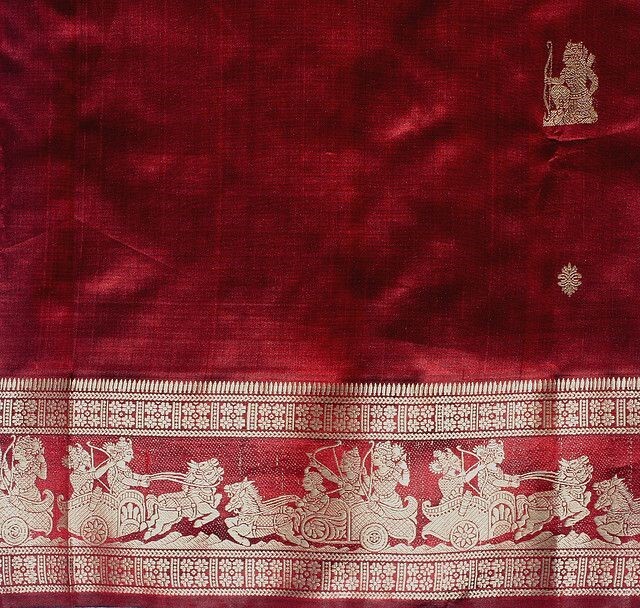
The imagery often includes the divine celebration of love between Radha and Krishna, complete with moon-lit circles, Sita’s exile, Shabari’s offering, Hanuman crossing the sea, Draupadi’s motif, scenes from royal courts of Nawabs, and many more. However, with contemporary evolution, weavers now incorporate Meenakari threads (gem-hued highlights) and Swarnachari that are made with a gleam of gold and silver Zari. Evocative floral patterns, vines, and Buttis often accompany the main design to complete the scenes.
Among the many mythical scenes depicted, one such scene is of Krishna and his devotees. As lord Krishna sits inside the enchanted forest surrounded by deer and ancient trees, whose rustling leaves sing the melodies of life, he begins to play his flute. Every living being and inanimate object that the melody from the flute touched entranced everyone, making the world come to a standstill. It was also a call to Krishna’s Gopis, the consorts and devotees, especially to Radha. As they are drawn towards Krishna and traverse lengths to reach him by tracing the rhythms of the flute, they finally reunite with their lord and their world.
For the weavers of Baluchari sarees, these are not whispers of history and myth. These are the forgotten stories and echoes of history that come alive in the weaves of the Baluchari sarees.
Draping the Timeless Legacy of Baluchari Sarees
To drape a Baluchari saree is to drape the devotion woven in silk and interlaced with the history and richness of the country’s diverse culture. Its meticulous artistry and epic storytelling are a living tradition that serves as a bridge between eras and people. Each fold and fall of the saree reminds us of the perseverance of the master artisans, who sat for hours behind the loom reinterpreting the designs for generations.
At Jaypore, we honour the craftsmanship of these very artisans, whose visions have altered the past and shaped history, and continue to do so in the present times. So, the next time you drape the Baluchari saree, let your finger trace the history through each weave and carry forward a story that has been centuries in the making.



 Storytellers of Wonder
Leave a comment