
“Yellamma Amma, in your strength we find our own.
May your blessings weave through our lives like threads that never break”
This is the story of breaking and becoming, of hands that once shaped clay and now shape strength.
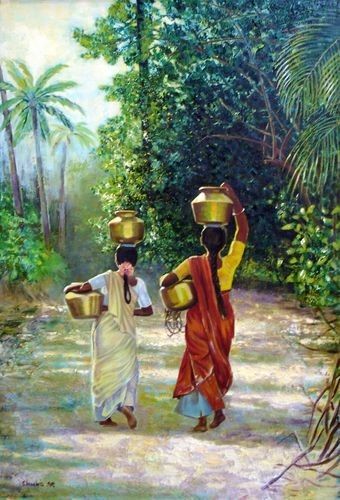
Renuka was known for a stillness so deep that even the river seemed to wait for her. Each morning, before sunrise brushed the sky, she walked to the water’s edge. The earth softened under her fingers as she shaped wet clay into a pot. It was never fired, never hardened by flame, yet it held. It held because she did. Her mind did not wander. Her devotion did not falter. The women who watched her believed she was touched by something beyond the ordinary rhythms of life.But even the steadiest mind is not free from a moment’s tremor.
One morning, as the river caught the shimmer of something distant, Renuka looked up. A passing reflection, a king perhaps, or a celestial figure. Laughter echoed across the water. For a single heartbeat, her thoughts followed it. Wonder entered. Not sin, not desire, just the fragile pull of being human. The clay slipped. The pot dissolved. When she returned home empty handed, her husband, Jamadagni, saw only failure. His anger rose like fire. He commanded his sons to strike her down. They refused, their hands trembling. All except one.
Parashurama stepped forward. Duty weighed heavier than love. In one irreversible act, he obeyed. The world seemed to fall silent. Later, when anger had cooled, a boon was offered. Parashurama asked for his mother’s life. Renuka returned, but something within her had shifted. She no longer belonged to the still perfection she had once embodied. She walked away, carrying the memory of judgment, of loss, of being broken for a moment’s humanity.
In her wandering, she became Yellamma. She was no longer distant or untouched, but a goddess who understood. Women came to her with their own unspoken stories. In her, they found compassion that felt lived and real. They brought her sarees. Simple ones, worn in fields and homes. Among them, the Patteda Anchu, with its checks and strong borders, steady and enduring. They draped it over her as if restoring her dignity. And in weddings, the saree is first offered to Yellamma, so that the bride receives not just cloth, but a blessing shaped by resilience, forgiveness, and the strength to begin again.
Table Of Content
- The Making of Patteda Anchu: Process and Identity
- Design Language & Motifs
- Artisans, Challenges, and Continuity
The Making of Patteda Anchu: Process and Identity
Originating in the weaving clusters of North Karnataka, particularly in Gajendragarh, Patteda Anchu is believed to date back to as early as the 10th century. Rooted in agrarian life, it emerged as a practical and durable saree for everyday wear, while also holding ritual significance in local traditions. Its process continues to follow a method where material, structure, and function are closely tied, with each step directly shaping its final character.
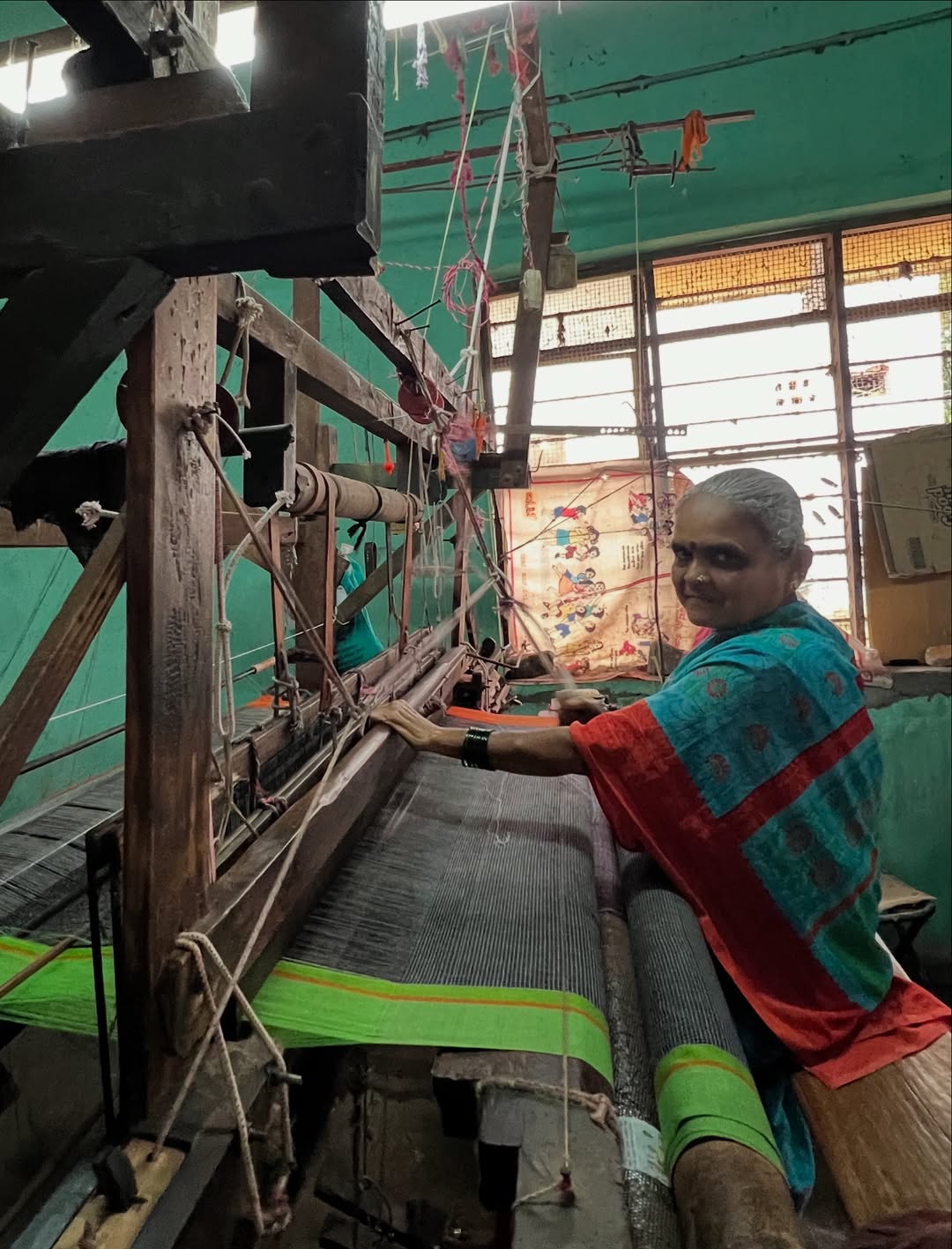
1. Preparing the cotton yarn: The process begins with locally suited cotton, spun into a slightly coarse, medium-count yarn. Unlike finer sarees meant for drape and sheen, Patteda Anchu uses sturdier yarns that prioritize strength and breathability. This choice reflects its origins as a working woman’s saree, built for repeated use rather than occasion wear.
2. Dyeing the threads: The yarn is dyed in grounded, earthy tones such as red, mustard, maroon, and indigo. Traditionally, colours were chosen for their availability and fastness rather than brightness. This gives Patteda Anchu its muted, lived-in palette, distinct from more decorative or high-contrast silk textiles.
3. Laying out the warp (defining the checks): Warp threads are stretched lengthwise with deliberate colour sequencing. The checks are not printed or added later but engineered directly into the structure through alternating-coloured yarns in both warp and weft. This grid-based planning is central to the identity of Patteda Anchu and distinguishes it from textiles where motifs are supplementary.
4. Setting up the traditional loom: The warp is mounted on a pit loom or frame loom commonly used in North Karnataka. These looms are manually operated and allow for tight control over tension. The simplicity of the loom contrasts with the precision required, as even minor inconsistencies can distort the checks.
5. Weaving the balanced plain weave structure: The body is woven in a plain weave, where each weft thread passes alternately over and under the warp. What makes it distinct is the balance between warp and weft colours, which produces the characteristic checks. The fabric is often reversible, with no clear front or back, adding to its practicality.
6. Creating the “Anchu” (structural border): The border is integrated during weaving, not attached later. It uses a contrasting colour and sometimes a denser thread arrangement, making it firmer than the body. Unlike decorative borders in many sarees, the anchu in Patteda Anchu serves both visual framing and reinforcement, preventing fraying with regular use.
7. Finishing and durability: After weaving, the saree is cut from the loom and hand-finished. Loose ends are secured without heavy post-processing. The fabric is intentionally left without excessive polishing or stiffening, preserving its raw texture and making it easy to maintain without ironing.
Design Language & Motifs
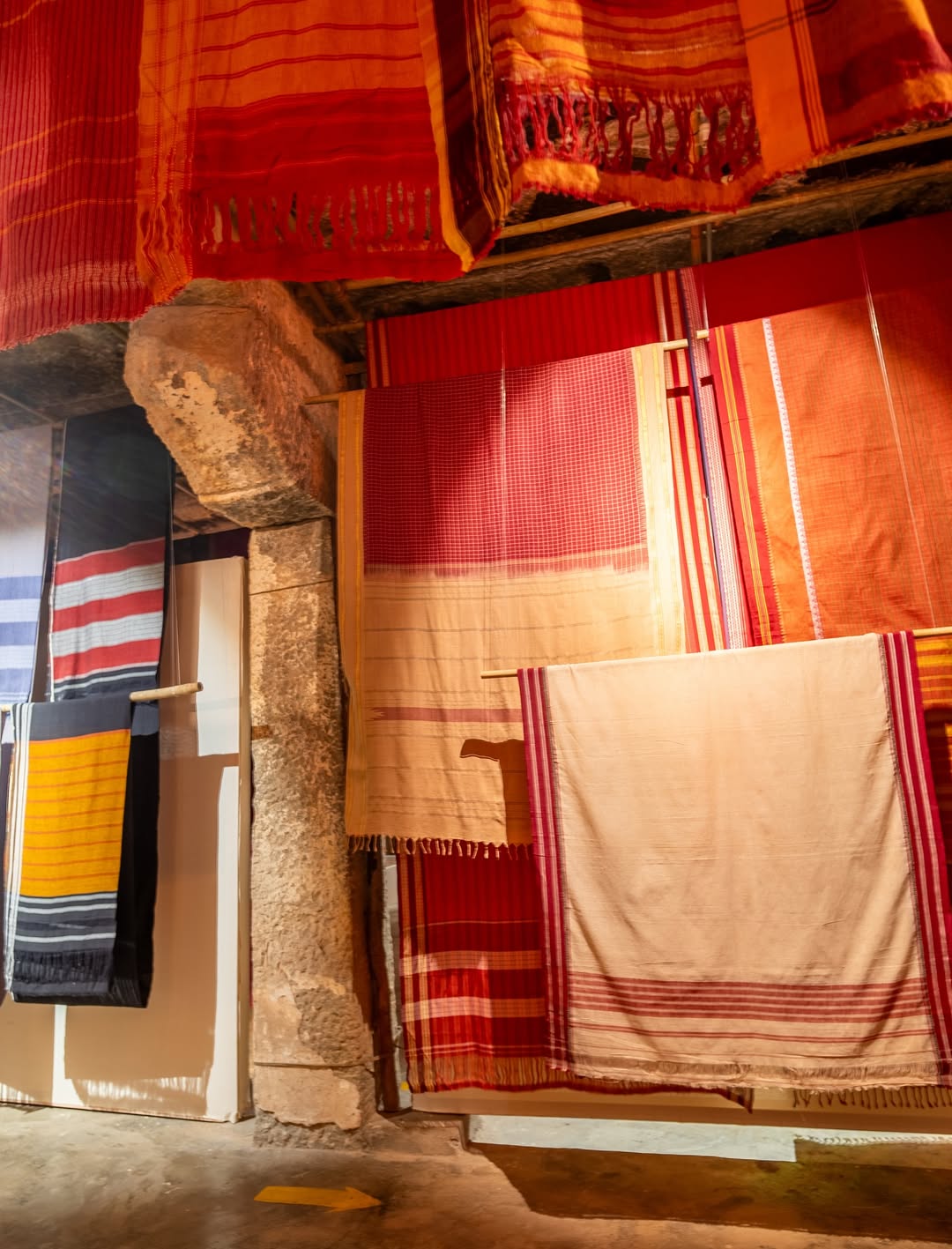
The weaves are defined by a restrained and highly structured design language where geometry takes precedence over ornamentation. The signature lies in its checks (patteda), created through the precise interlocking of colored warp and weft, forming balanced grids that feel rhythmic rather than decorative. The border (anchu) is bold yet functional, usually in a contrasting color, acting as a visual frame that anchors the composition. The color palette draws from earthy tones like red, mustard, maroon, and indigo, chosen for depth and longevity rather than brightness. What sets Patteda Anchu apart is its reliance on simplicity and symmetry, there are no elaborate motifs, only repetition and proportion, where the beauty emerges from alignment, balance, and the quiet confidence of structure.
Artisans, Challenges, and Continuity
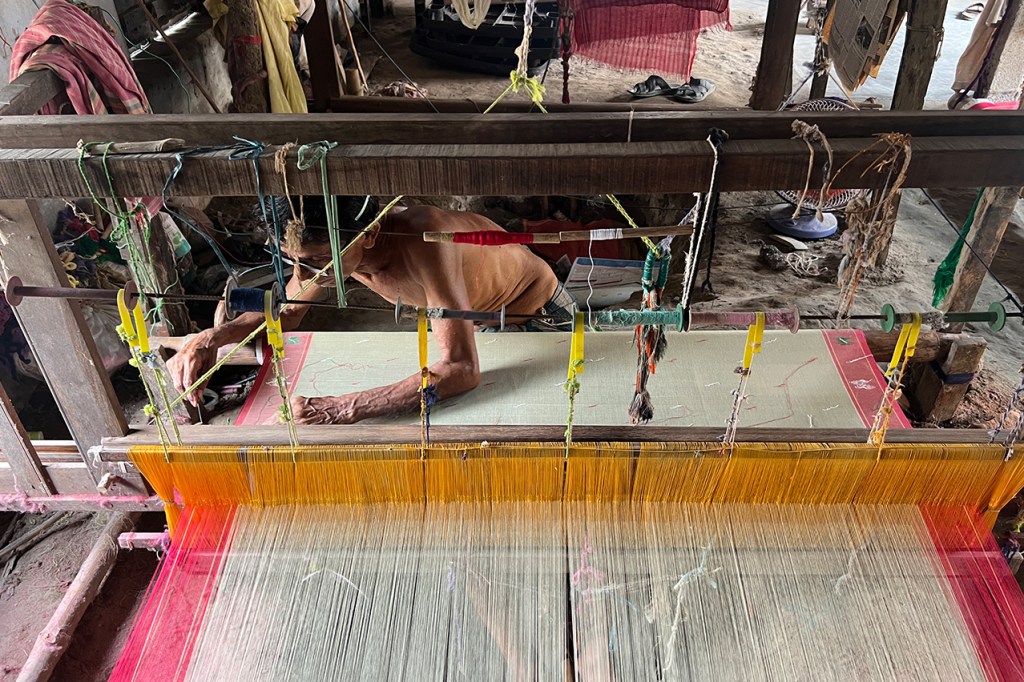
The survival of the craft depends on a small community of artisans who continue to work on traditional looms despite shrinking demand and competition from faster, cheaper powerloom imitations. Many weavers face irregular income, limited market access, and a gradual loss of generational knowledge as younger members move away from the craft. Revival efforts have helped, but sustaining the weave requires consistent support. Choosing Patteda Anchu is not just about buying a textile, it is closer to supporting a living practice, where each saree carries time, skill, and cultural memory. In doing so, it helps preserve both livelihoods and a distinct handloom identity rooted in everyday life and ritual, including its association with Yellamma.
In every Patteda Anchu, there is a sense of balance that feels both lived and lasting. What began as a saree of everyday resilience continues to carry its story forward through the hands that weave it and the people who choose it. At Jaypore, this journey finds a thoughtful continuation, where heritage is not just preserved but made relevant for today, allowing each piece to remain rooted in craft while finding its place in the modern world.

 Storytellers of Wonder
Leave a comment